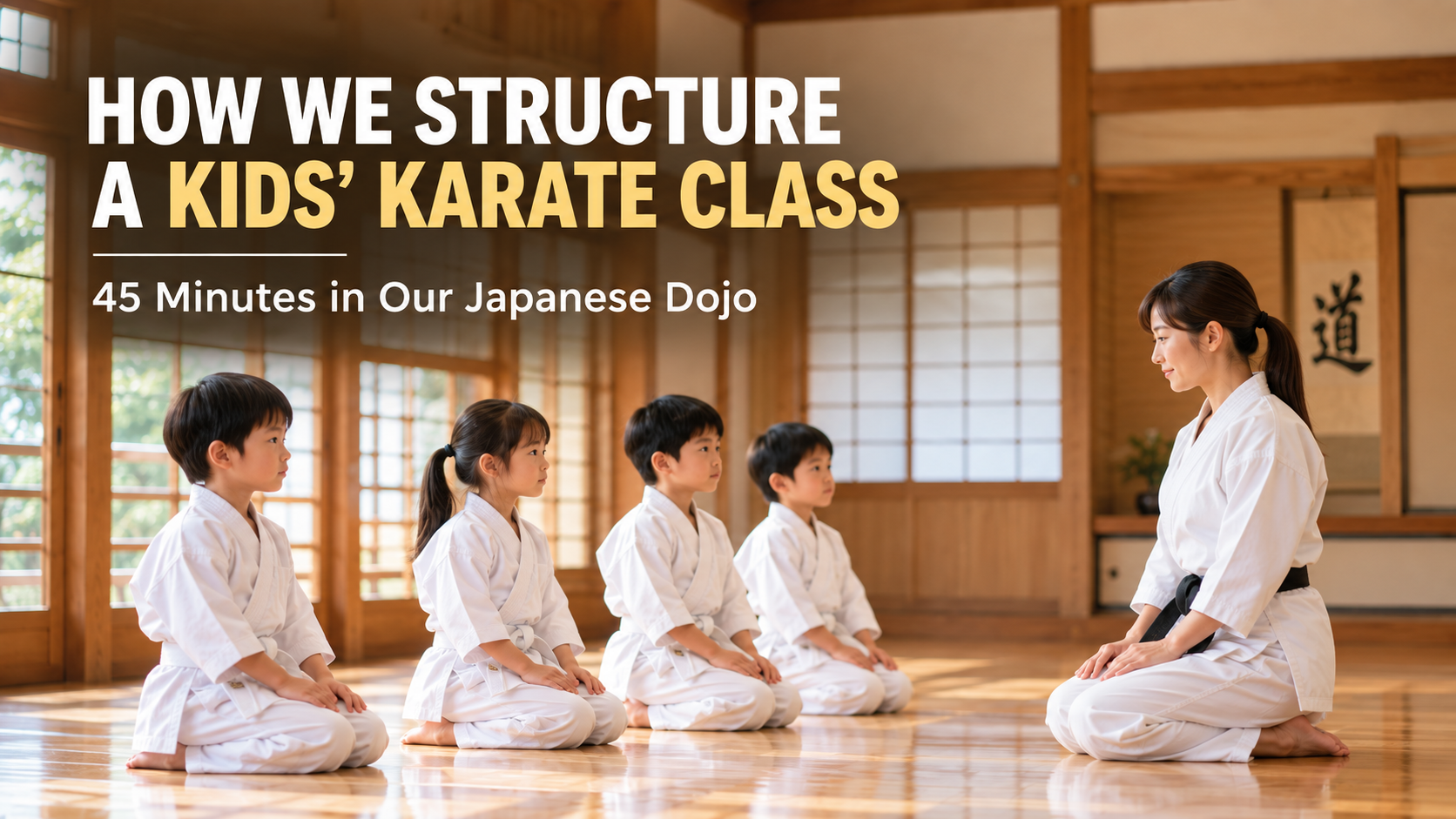
A children’s karate class does not have to be long to be effective.
In our dojo in Japan, our regular children’s class is only 45 minutes.
That may sound short. In fact, compared with many martial arts classes, it probably is.
But that is intentional.
Children cannot maintain the same level of concentration indefinitely. Rather than keeping them on the floor for a long time while their attention gradually disappears, we prefer a shorter class with a clear rhythm.
Our basic idea is simple:
Teach children to concentrate deeply for a short period rather than practice half-heartedly for a long one.
For us, that is not only a karate lesson. It is also part of education.
- Our Basic 45-Minute Kids’ Karate Class
- We Begin by Changing the Children’s State of Mind
- Why Children Do Kihon → Kumite → Kata
- A Longer Class Is Not Automatically a Better Class
- The Schedule Is Consistent, but the Training Is Not Identical Every Week
- Most of Our Kids’ Classes Are Mixed-Level
- Beginners Do Not Need Everything Explained Before They Join In
- But We Do Not Ignore Every Mistake
- What Other Instructors Can Take From Our Class Structure
Our Basic 45-Minute Kids’ Karate Class
A typical class looks roughly like this:
| Part of Class | Approx. Time |
|---|---|
| Bowing, short reading, and kihon | First 15 min |
| Kumite practice | 15 min |
| Kata practice | 15 min |
If it is the first class of the day, we also include a warm-up.
The exact content changes depending on the season, upcoming gradings, competitions, and the students in front of us. But kihon, kumite, and kata in three roughly 15-minute blocks is our usual framework.
For an introduction to these three parts of training, see What Is Karate? A Simple Beginner’s Guide.
The important word here is framework.
The structure is relatively stable.
The content inside it is flexible.
We Begin by Changing the Children’s State of Mind
At the beginning of the children’s class, the students sit formally, bow, and read a short traditional passage related to etiquette, discipline, and self-control.
The specific passage is part of our dojo tradition, so I will leave the wording aside here.
What matters is the purpose.
Karate is not only about learning how to punch, kick, or perform kata. How a student behaves, pays attention, responds to instruction, and treats other people also matters.
So before the physical practice begins, we create a clear transition:
Now you are in the dojo. Now you practice karate.
This does not mean every class in our dojo follows exactly the same ritual.
For example, the adult class does not do this reading. Adults have different physical needs and different ways of preparing themselves for training.
The structure should serve the students—not the other way around.
Why Children Do Kihon → Kumite → Kata
Our adult classes usually follow a more conventional order:
kihon → kata → kumite
But with children, we deliberately change it:
kihon → kumite → kata
Why?
Because children’s attention changes during a class.
At the beginning, while they are still relatively fresh, we ask them to concentrate on kihon.
Basic techniques require repetition, and repetition is essential in karate. But if we continue with highly focused technical practice for too long, many children begin to lose concentration.
We explore the role of repeated practice in Why Do Karate Practitioners Practice the Same Things Again and Again?.
So after kihon, we change the rhythm.
We move into kumite practice.
The children can move more freely, react to another person, and experience something different from repeated basic techniques. Sometimes we also use pads or similar equipment.
You could say that kumite gives their attention a reset.
Then, instead of ending the lesson in that more energetic state, we return to kata.
Kata requires them to focus again.
They have to remember sequences, control their movements, and pay attention to what the instructor and the people around them are doing.
So the class finishes with the children composed and concentrating again.
For us, the order of the exercises is also a way of managing attention.
A Longer Class Is Not Automatically a Better Class
One question an instructor might ask is:
Is 45 minutes really enough?
Our answer would be that children cannot concentrate endlessly simply because an instructor has scheduled a longer lesson.
A long class is not necessarily productive if the second half becomes unfocused.
When concentration starts to disappear, we can usually see it.
Children stop responding when spoken to.
They no longer really listen to the explanation.
Their movements become careless.
At that point, simply keeping them training for another thirty or forty minutes does not automatically teach discipline.
We would rather help children develop the habit of concentrating properly during a limited period of time.
If a child becomes accustomed to spending a long time doing something without real attention, that habit can extend beyond karate as well.
So the goal is not:
“How long can we keep the child in class?”
It is:
“How well can the child practice during the time we have?”
The Schedule Is Consistent, but the Training Is Not Identical Every Week
Consistency matters in karate.
Our kihon practice, in particular, often contains the same fundamental techniques.
Children need repetition.
But repetition creates another problem:
They get bored.
So although the training objective may stay the same, we sometimes change the way we present it.
A slightly different drill, emphasis, pairing, or exercise can make familiar material feel new without abandoning the fundamentals.
The same applies to the overall 15–15–15 structure.
It is our default, not an absolute rule.
Before a grading, for example, kata practice may take a larger share of the class, and students may be separated according to grade so that they can prepare the kata required for their level.
Before a competition, the balance may change again.
Immediately after a grading, we often spend relatively more time on kumite or pad work.
The framework gives the class stability.
The instructor still has to respond to what the students need.
Most of Our Kids’ Classes Are Mixed-Level
Our children’s classes are mainly for elementary-school-aged students, although younger children sometimes join as well.
By junior high school, students normally join the adult class.
In many of our children’s classes, beginners and advanced students train together.
A white belt may therefore be standing next to someone who has practiced karate for years.
At some locations, when numbers allow it, the class may be divided—for example, lower-ranked students up to purple belt in one group and green belt and above in another.
But mixed-level training itself is not something we necessarily try to avoid.
That is partly because of how we think karate is learned.
Beginners Do Not Need Everything Explained Before They Join In
There is a tendency to think that beginners—especially children—must first receive detailed individual instruction before they can participate properly.
That is not how we approach everything.
Karate is learned partly by watching and imitating.
If a beginner does not know the sequence of a kata yet, we may still have them stand with everyone else and try to follow.
They watch the instructor.
They watch the more experienced students.
They copy.
At first, they may be completely lost.
Then they begin to recognize sections.
Eventually, without someone having stopped the whole class to explain every single movement individually, they can follow much more of the kata.
This is one advantage of a mixed-level class.
A beginner is surrounded by examples.
We do teach them, of course.
But we do not assume that good teaching always means explaining every movement step by step.
Sometimes the child needs time to see, imitate, repeat, and gradually understand.
But We Do Not Ignore Every Mistake
This raises an important question.
If a beginner is copying the kata incorrectly, should the instructor immediately correct them?
It depends on the mistake.
For a complete beginner, the first goal may simply be:
Learn the sequence and get through the kata.
At that stage, correcting every hand position, angle, stance, and small technical detail would overwhelm the student.
So we let many minor details wait.
But some mistakes are different.
Footwork, trunk movement, and the way the body turns can become deeply ingrained habits.
For example, when changing direction, how the student uses the trunk and rotates the body may be important enough that we correct it carefully from an early stage.
Why?
Because once a movement pattern becomes a habit, changing it later can be much harder.
So we make a distinction between:
mistakes that can wait
and
fundamental movement patterns that should be corrected early.
This is especially important when teaching children.
More correction is not always better teaching.
The question is whether the correction matters at this stage of the student’s development.
For a related example of noticing and correcting unnecessary tension, see Why Do Karate Instructors Keep Telling You to Relax?.
What Other Instructors Can Take From Our Class Structure
I do not think every dojo should copy our 45-minute schedule.
Different dojos have different students, traditions, facilities, instructors, and goals.
And this is only one example from our dojo in Japan.
But there are several principles behind the structure that may be useful elsewhere.
A children’s class does not necessarily need to be long.
The rhythm of a class can matter as much as the content.
A fixed structure can coexist with flexible teaching.
Beginners can learn a great deal through observation and imitation.
And instructors do not need to correct everything immediately.
Perhaps the most important question is not:
“How much karate can I fit into this class?”
It is:
“How can I keep the students genuinely learning from beginning to end?”
For our children, 45 minutes is often enough.
Because the goal is not simply to spend more time practicing.
The goal is to learn how to practice well.
Comments