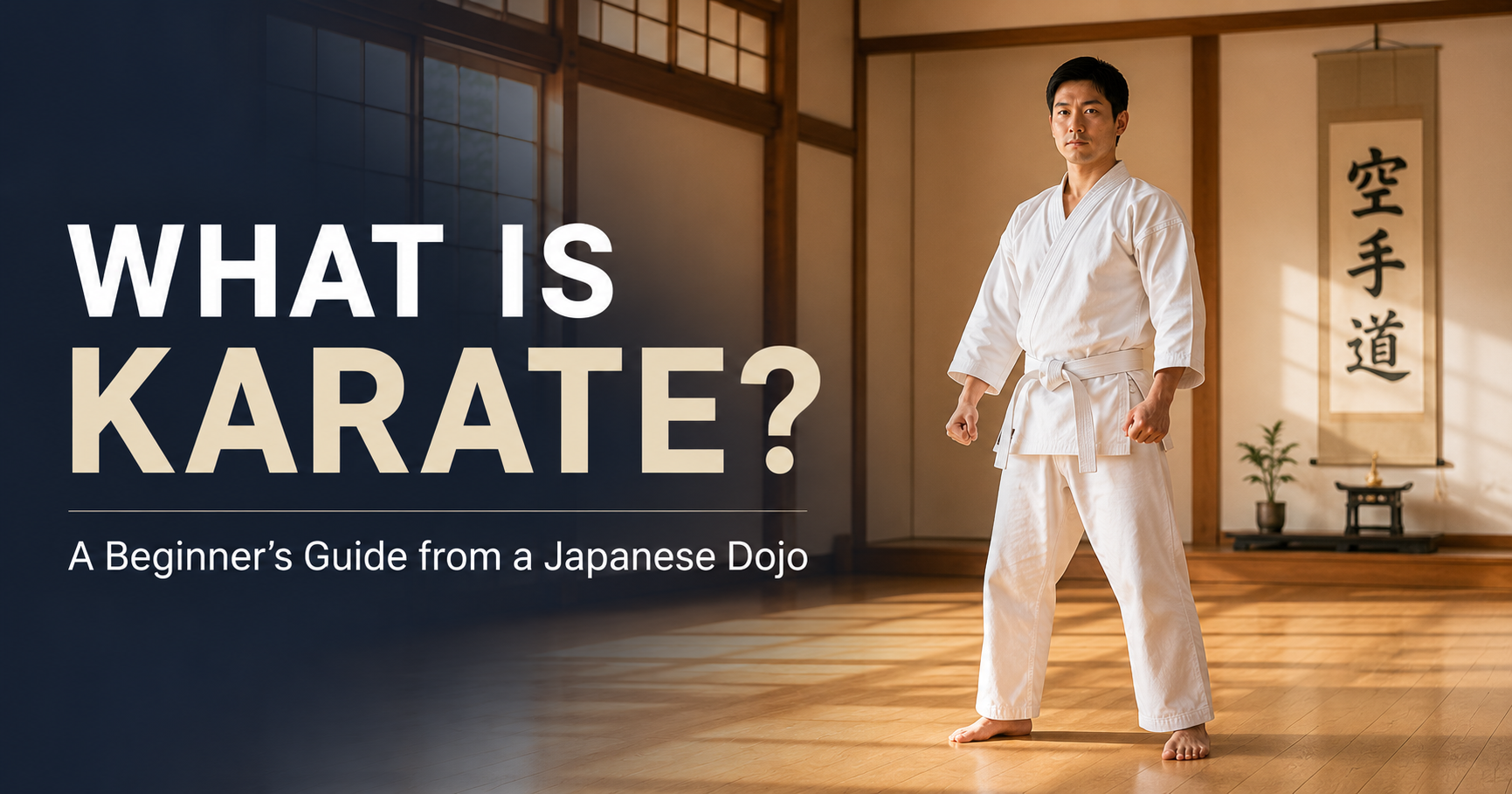
Punches. Kicks. White uniforms. Black belts.
These are probably some of the first things that come to mind when you hear the word karate.
And they are part of karate.
But if you actually walk into a karate dojo, you may be surprised by what you see.
Students may spend a long time practicing the same basic punch.
Someone may perform a sequence of movements completely alone.
People bow before and after training together.
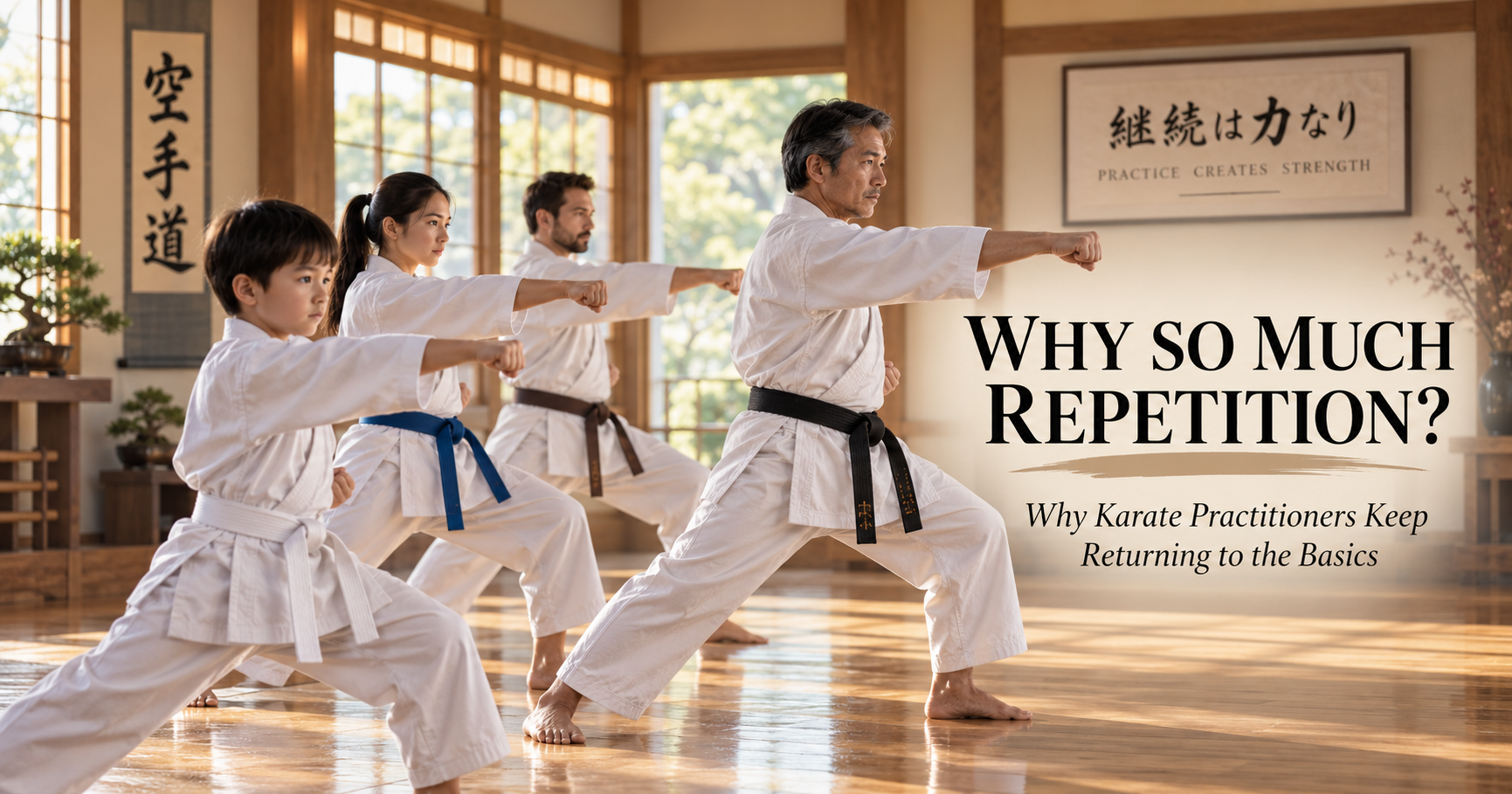
And even experienced black belts still practice basic stances and techniques.
So what exactly is karate?
At its simplest, karate is a martial art in which people learn how to strike, defend, move, and respond to another person.
But karate training is not only about learning more punches and kicks.
It is also about learning how to use your body well.
To understand how that works, there are three basic parts of karate you should know:
kihon, kata, and kumite.
1. Kihon: The Basics
Kihon means basic techniques.
This includes things such as:
- punches
- kicks
- blocks
- stances
- footwork
Beginners practice them.
Black belts practice them too.
That may sound strange.
If someone has trained for many years, shouldn’t they have finished learning the basics?
In karate, the answer is no.
A basic technique may look simple, but there is always more to improve.
At first, a beginner may simply be trying to remember where to put their hands and feet.
Later, they begin noticing different things.
Am I using too much tension?
Is my balance good?
Are my shoulders rising?
Can I move again immediately after the technique?
The movement may be the same.
What the student notices changes.
That is one reason karate practitioners keep returning to the basics.
2. Kata: Practicing a Fight Without an Opponent
Kata is a predetermined sequence of karate movements.
A person performs it alone.
They may block, punch, kick, turn, and change stances even though nobody is physically attacking them.
For someone seeing karate for the first time, this can look a little strange.
Why fight someone who is not there?
One simple way to understand kata is this:
It gives you a controlled situation in which to practice how karate movements connect.
Because there is no real opponent changing the situation, you can pay more attention to your own body.
Your balance.
Your posture.
Your breathing.
Unnecessary tension.
The way one movement leads into the next.
A kata can often be memorized much faster than it can be mastered.
That is why karate practitioners may practice the same forms for many years.
3. Kumite: Training With Another Person
Kumite means training with a partner.
There are many kinds of kumite.
Some exercises are carefully arranged in advance. Others are much freer and look more like sparring.
The important difference is that now another person is involved.
And another person makes things unpredictable.
They may be taller than you.
Faster than you.
Closer than you expected.
They may move at the wrong moment — at least, the wrong moment for your plan.
A technique that felt easy when you practiced it alone can suddenly become difficult.
That is part of the point.
Kumite teaches you to adjust what you have practiced to a real, changing person.
Kihon, Kata, and Kumite Work Together
It can help to think of karate like learning a language.
Kihon is learning the words.
Kata is learning how the words fit together.
Kumite is having a conversation with someone else.
If you only memorize words, you cannot really have a conversation.
If you only try to have conversations without learning the basics, communication becomes difficult.
Karate works in a similar way.
The three forms of practice support each other.
Why Do Karate Students Bow?
If you are unfamiliar with Japanese martial arts, you may also wonder why karate students bow so often.
They may bow when entering the training area.
They bow at the beginning and end of practice.
They may bow to an instructor or to a training partner.
Part of this is etiquette.
But there is also a very practical idea behind it.
In karate, you are practicing techniques with another person’s body.
Your partner allows you to train.
You are responsible for controlling what you do.
They are responsible for doing the same.
The bow is a simple way of acknowledging that relationship.
It marks the beginning and the end of training together.
So in a karate dojo, manners are not completely separate from technique.
How you treat the person in front of you is also part of the practice.
Is Karate Just About Fighting?
Karate is a martial art, so fighting is part of its foundation.
Punches need targets.
Blocks make sense because something is coming toward you.
Distance and timing matter because another person is moving.
But this does not mean that every karate class is about trying to defeat someone.
A large part of training may involve repeating simple movements, practicing kata, working with a partner in controlled exercises, and learning how to move with less unnecessary tension.
Over time, students begin to notice things that are harder to see from the outside.
When they become stiff.
When their balance is poor.
When they are trying too hard.
When they move too early.
When they are too slow to respond.
In this sense, karate is not only about learning techniques.
It is also about learning to notice what your own body is doing.
Do I Need to Understand All of This Before Starting Karate?
No.
Not at all.
A beginner does not need to understand Japanese culture, karate philosophy, or every strange-looking dojo custom before starting.
You begin with simple things.
Stand here.
Move your foot here.
Make a fist.
Watch.
Try.
Repeat.
At first, that is enough.
Later, you may discover that something you thought was simple contains much more than you expected.
That is normal in karate.
So, What Is Karate?
Karate is a martial art built around striking, defending, movement, and interaction with another person.
Its training commonly includes:
kihon — basic techniques
kata — predetermined forms
kumite — partner practice
But those are only the visible structure.
As students continue practicing, they also learn about balance, timing, distance, relaxation, control, and how to respond when things do not go exactly as planned.
You do not need to understand all of that on your first day.
You just start with the basics.
And in karate, even after many years, there is always something new to find in them.
Karate varies between styles, organizations, instructors, and individual dojos. This article is a simple introduction rather than a description of how every karate dojo practices.
Comments