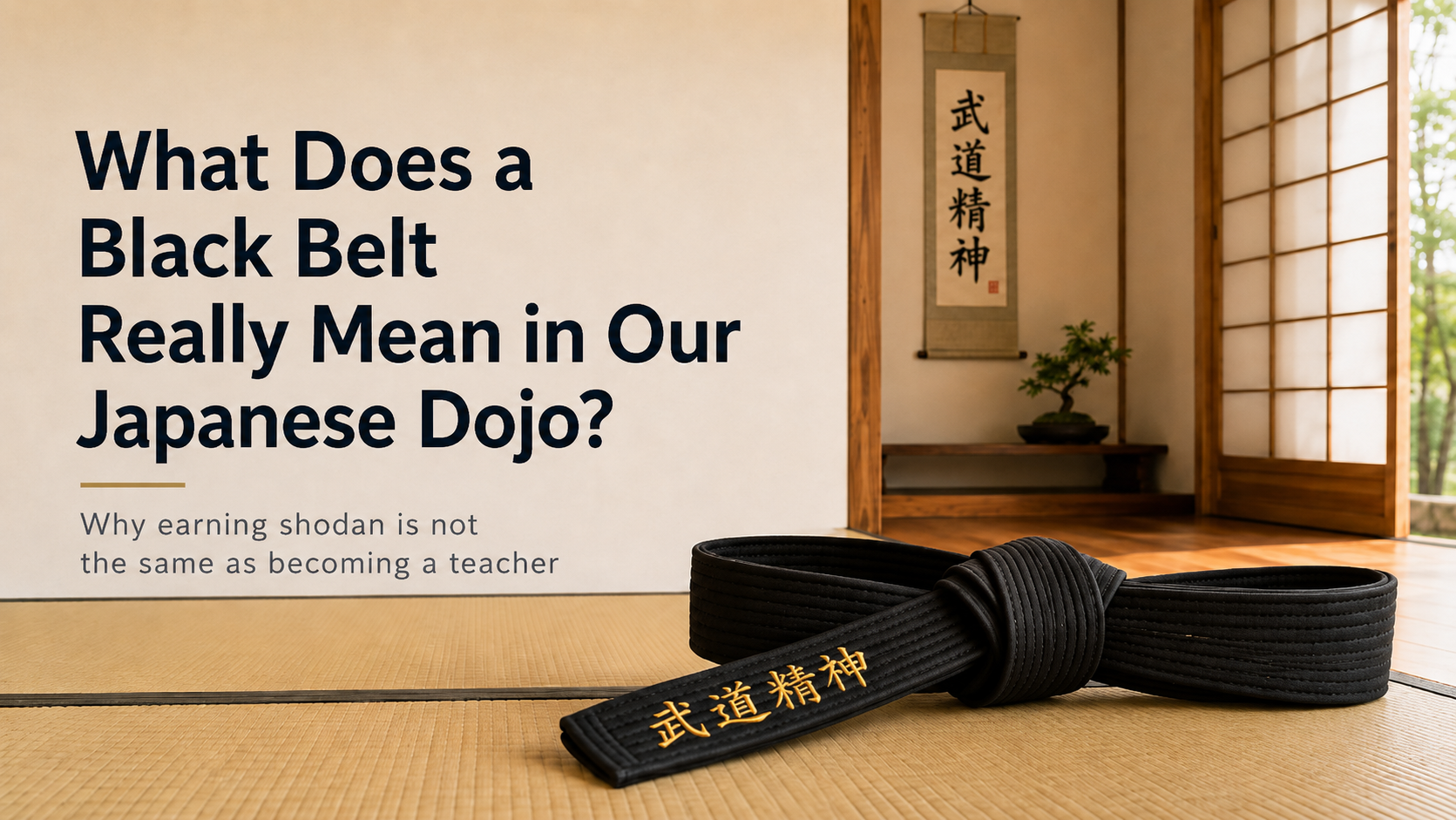
Why earning shodan is not the same as becoming a teacher
For many people who begin karate, the black belt looks like the final destination.
You start with a white belt.
You move through the kyu grades.
You practice for years.
And eventually, you reach black belt.
So you have made it.
Right?
Not quite.
In our dojo in Japan, earning a black belt is certainly an important achievement. We celebrate it. We recognize how much work it took to get there.
But we do not see shodan — first-degree black belt — as proof that someone has mastered karate.
And we definitely do not see it as meaning:
“Now you are a karate teacher.”
In many ways, it is the opposite.
Black belt is where a new stage of training begins.
This article is presented in a Q&A format based on the author’s experience teaching karate in a dojo in Japan. Practices and expectations vary between organizations and individual dojos.
If you’re curious about how our kyu ranks, belt colors, and grading system work, see: [How Karate Belt Rankings Really Work in Our Japanese Dojo].
Q. Who decides when a student is ready to test for black belt?
The instructor does.
In our dojo, a brown-belt student does not simply decide:
“I want to take my black belt test now.”
There is no fixed rule such as “you must spend exactly six months at brown belt” or “you must attend a certain number of classes.”
Instead, the head instructor watches the student over time.
When the instructor believes the student is ready to attempt the examination, he tells them.
This often happens around one of our regular kyu grading periods.
That distinction is important.
A black belt examination is not something you take simply because enough time has passed.
You are invited to attempt it because the people responsible for your training believe you may be ready.
Q. What does “ready” mean?
Technical ability is obviously important.
A student cannot become a black belt without karate skill.
But technique is only part of the decision.
As students approach black belt, we increasingly look at whether their shin-gi-tai — mind, technique, and body — have developed together.
This becomes particularly noticeable with children.
Sometimes a young student is technically very talented. They remember kata easily. They move well. They progress much faster than the other children in their class.
But their maturity may not have developed at the same speed.
That matters.
If a child is skilled enough to wear a black belt but is still likely to show off, misuse techniques, behave badly toward younger students, or use karate outside the dojo irresponsibly, we may decide that they are not ready.
Being able to perform karate and being ready to carry the status of a black belt are not exactly the same thing.
Q. Is it different for adults?
Often, yes — but almost in the opposite direction.
With children, technique can sometimes develop faster than maturity.
With adults, maturity is usually not the problem.
Technique is.
Adults may understand instructions very well. They may be responsible, respectful, and serious about training.
But their bodies do not always learn as quickly as their minds.
The answer is not complicated:
They need to train.
Again and again.
There is no shortcut around practice.
Q. So what changes when someone finally earns a black belt?
Their role in the dojo begins to change.
A new black belt may start doing things such as:
- helping lower-ranked students remember the order of a kata
- leading the warm-up
- helping organize children during class
- standing in front as an example
- assisting with dojo activities or grading events
These may sound like small things.
But they reflect an important change.
Before black belt, a student is mainly responsible for their own training.
After black belt, other people start watching them.
Especially children.
Especially beginners.
A black belt becomes part of the environment in which lower-ranked students learn what karate looks like.
That creates responsibility.
Q. Does that mean a black belt can teach karate?
Not necessarily.
This is one of the most important distinctions in our dojo.
A black belt may help a junior student remember what comes next.
But that does not automatically mean they should explain how the technique should be performed.
Imagine that a beginner asks a new black belt:
“How should I do this technique?”
The correct answer is not to invent an explanation simply because you are wearing a black belt.
A better answer is:
“Let’s go ask Sensei together.”
That may seem overly cautious to some people.
But teaching technique means taking responsibility for another person’s karate.
If you are not yet qualified to do that, admitting it is not weakness.
It is good judgment.
Q. So a black belt is not the same thing as a Sensei?
Absolutely not.
In our dojo, there is a very clear difference between:
having a black belt
and
being a teacher.
A person with shodan is a black belt.
That alone does not make them Sensei.
Within our dojo, higher ranks and teaching roles are treated separately. As a rough internal standard, the title Sensei is associated with considerably more experience than shodan, while Shihan is reserved for still more senior instructors.
The exact rank conventions differ among karate organizations, so the numbers themselves are less important than the principle:
Black belt is a student rank before it is a teaching qualification.
This matters because someone can know the sequence of a kata without understanding its technical details deeply enough to correct another person.
They can perform karate without yet knowing how to teach karate.
Those are different skills.
Q. Why do people say “real training starts at black belt”?
Because before black belt, much of your attention is occupied by learning the basic structure of karate.
Where do I put my foot?
What comes next in this kata?
Which direction do I turn?
What is the name of this technique?
How do I make this stance?
Those questions are necessary.
But they are only the beginning.
Once the basic movements become familiar, your questions can start changing.
Why does this movement work this way?
What is happening to my balance?
Where is my weight?
Why does the same technique feel different when my timing changes?
What is my instructor seeing that I still cannot feel?
You are no longer only trying to remember karate.
You begin trying to understand it.
That is one reason we often say:
Black belt is where real training begins.
Q. Does a student change immediately after receiving a black belt?
Sometimes, surprisingly, yes.
There are students who put on a black belt and suddenly stand differently.
Not technically.
Mentally.
They become more serious during training.
They begin paying attention to the younger students around them.
They feel that other people are watching.
They start acting as if they have been given responsibility — because, in a sense, they have.
The belt itself can change behavior.
That is one reason rank can be a useful educational tool.
But the effect does not always last forever.
Q. What happens after the excitement wears off?
This is very human.
A student earns a black belt.
For a while, motivation is extremely high.
They train seriously. They feel proud. They have reached something they worked toward for years.
Then life continues.
School becomes busy.
Work becomes busy.
Other interests appear.
Training becomes normal again.
Some students begin coming less often.
Adults do this too.
And occasionally, someone earns a black belt and then stops karate almost immediately.
Q. Is that disappointing?
Of course we would rather they continue.
We want students to discover what lies beyond shodan.
There is much more karate after black belt than before it.
But if someone trains until black belt and then stops, I do not think everything before that becomes meaningless.
I would rather see someone reach black belt and stop than quit at brown belt simply because the final challenge felt too difficult.
At least they completed something significant.
We can say:
You worked hard. You reached an important point.
Hopefully, the experience of doing that remains with them even if karate does not.
Q. What kind of person should not receive a black belt?
Someone whose behavior makes us unable to trust them with it.
Technical ability alone is not enough.
If someone is violent, dishonest, selfish, disrespectful toward juniors, or consistently irresponsible in training, those things matter.
This is karate.
We are deliberately teaching people skills that can hurt someone.
It would make little sense to say that character is irrelevant.
The higher a student progresses, the more important the question becomes:
Can we trust this person with what we are teaching them?
A black belt is visible.
Other students see it.
Children see it.
People assume that the person wearing it represents the dojo to some degree.
So the decision is not simply:
“Is this person’s technique good enough?”
It is also:
“Is this person ready to represent this level?”
Q. What changes from first dan to second dan, third dan, and beyond?
It cannot simply be “the same karate, but better.”
Technical skill should continue improving, of course.
But over time, other things should develop too:
- understanding of karate
- ability to observe other people
- judgment
- responsibility
- teaching ability
- character
A student begins by asking:
“How do I do this?”
Later, they may begin asking:
“Why do we do this?”
Eventually, some will have to answer another question:
“How do I help someone else understand this?”
Those are different stages of development.
A higher dan grade should represent more than collecting another certificate.
Q. Do you do anything special when a student earns their first black belt?
Yes.
The first black belt itself is given to the student as a gift from the dojo and the head instructor.
We see it as recognition that they have overcome their first major challenge in karate.
Kyu grading takes place within the dojo, where the instructors already know the student very well.
Dan examinations are different.
Students eventually have to demonstrate their karate beyond the comfortable environment of their usual class and meet an external standard.
Passing that first major examination deserves recognition.
So the black belt is our gift to them.
Not because the journey is finished.
Because they have earned the right to begin the next part of it.
Q. What do you think when you see one of your students wearing a black belt for the first time?
Mostly:
You worked hard.
But I also hope they take what they learned from the experience and use it somewhere beyond karate.
Maybe in school.
Maybe in their work.
Maybe when something else in life becomes difficult.
They worked toward something for a long time.
They struggled.
They kept practicing.
And eventually, they achieved it.
I want them to remember that.
And then I have one more hope:
Keep going.
Do not let black belt become the end of your karate.
Train longer.
Look deeper.
There is much more ahead.
A Black Belt Is an Achievement — and a Beginning
A black belt matters.
We should not pretend that it does not.
For many students, earning shodan represents years of practice, frustration, improvement, and perseverance.
That deserves to be celebrated.
But the meaning of the belt changes once you receive it.
Before black belt, you are looking upward.
After black belt, someone else may be looking up at you.
That is when responsibility begins.
You still have teachers.
You still have weaknesses.
You still have techniques you do not understand.
You are not suddenly a Sensei.
You have simply reached a point where you know enough karate to understand how much more there is to learn.
And perhaps that is one of the most important things a first black belt can teach you.
Inside the Japanese Dojo explores how karate is understood, taught, and run in Japan. Practices vary by dojo, instructor, and organization; the articles here present experiences from one Japanese dojo rather than claiming to represent every karate school in Japan.


Comments