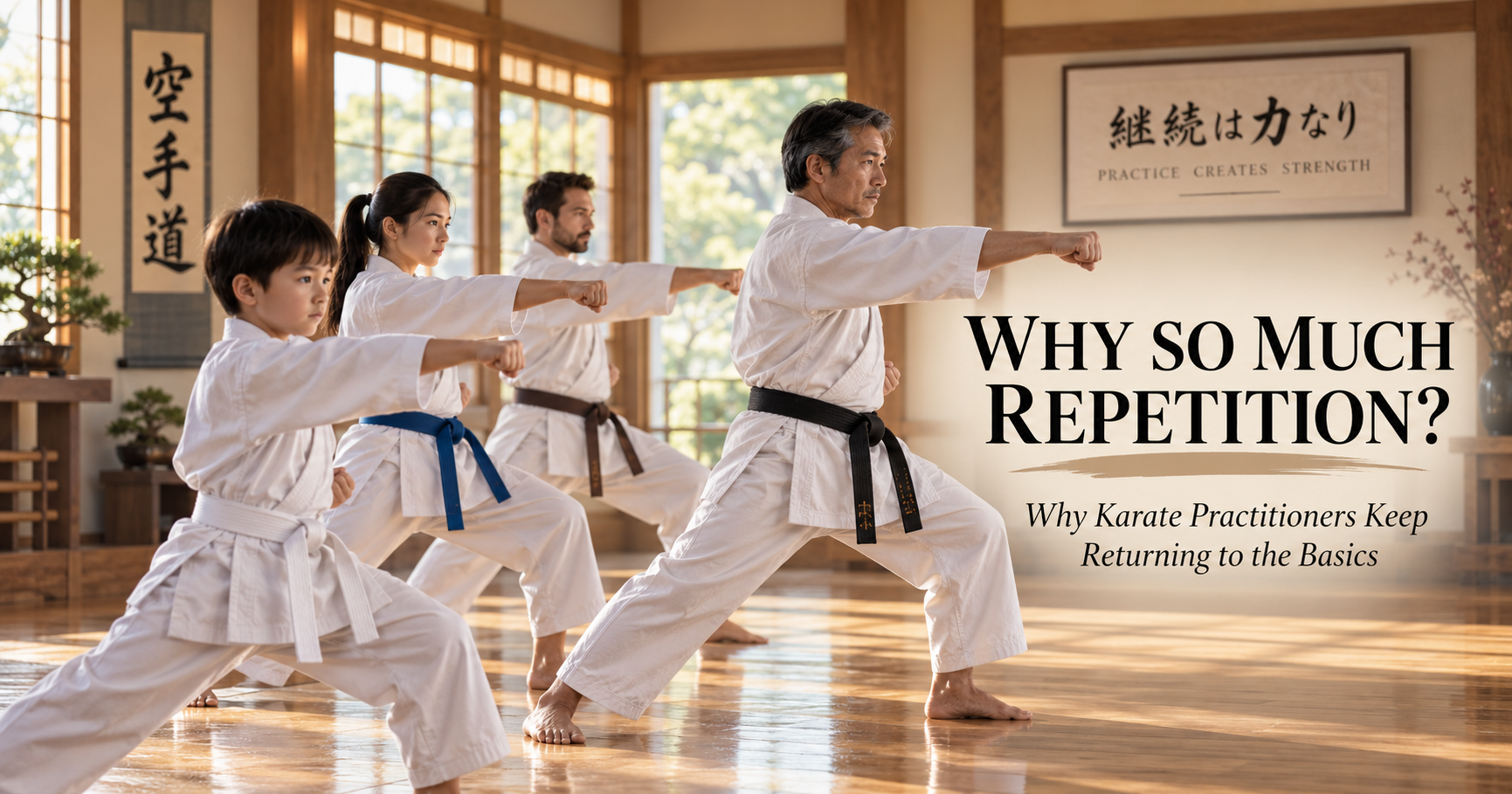
Watch a karate class for a while and you may notice something strange.
Beginners practice punches.
Black belts practice punches.
Beginners practice basic stances.
Black belts practice basic stances.
And some karate practitioners perform the same kata they have already practiced hundreds — perhaps thousands — of times.
Why?
If you already know the movement, why keep doing it?
The simple answer is that repetition in karate is not only about remembering a technique. It is also a way of noticing more about it.
The movement may stay the same.
The person practicing it does not.
If you are new to karate, you may first want to read What Is Karate? A Simple Beginner’s Guide, which introduces kihon, kata, and kumite and how they work together.
Here, we will look at why karate keeps returning to the same movements.
- At First, You Are Just Trying to Remember What to Do
- The Movement Stays the Same, but What You Notice Changes
- Understanding Something Is Not the Same as Being Able to Do It
- Repetition Makes Your Habits Harder to Hide
- Why Do Black Belts Still Practice Basics?
- Repetition Is Not About Making Every Movement Identical
- But Can Repetition Become Mindless?
- You Do Not Need to Fix Everything at Once
- The Same Kata Can Teach Different Things at Different Times
- Karate Often Moves Forward by Returning
- So Why Repeat the Same Things?
- Continue Learning About Karate
At First, You Are Just Trying to Remember What to Do
Imagine learning a basic punch for the first time.
There is already a lot to think about.
Which foot goes forward?
Where should the fist begin?
Where should it finish?
What should the other hand do?
How should you stand?
At this stage, simply reproducing the movement can require most of your attention.
The same is true with kata. A beginner may be thinking mainly about the sequence:
Where do I turn next?
Which technique comes after this one?
Which direction am I facing?
That is completely normal.
But once the order becomes familiar, something interesting happens.
Your attention becomes available for other things.
The Movement Stays the Same, but What You Notice Changes
After practicing the same punch many times, you may no longer need to think about which hand moves.
Now you may notice that your shoulder rises every time you punch.
Later, you may notice that you hold your breath.
Later still, you may realize that your body becomes stiff just before the technique begins.
Nothing obvious about the exercise has changed.
You have changed enough to notice something that was previously hidden by the difficulty of simply doing the movement.
This is one reason experienced karate practitioners continue practicing basic techniques.
They are not necessarily working on the same problem as a beginner, even when they appear to be doing exactly the same exercise.
A beginner and a black belt may perform the same punch side by side, but their attention can be in completely different places.
Understanding Something Is Not the Same as Being Able to Do It
Karate also teaches a frustrating lesson:
You can understand a correction and still fail to do it.
An instructor might tell you to relax your shoulders.
You understand the words immediately.
Then you punch — and your shoulders rise again.
You may know that you should keep your balance.
Then you move quickly — and lose it.
You may know that you should stay relaxed during kumite.
Then another person attacks — and your whole body becomes tense.
This is because physical skill is not learned only through explanation.
The body needs practice.
That takes time.
Repetition gives you repeated opportunities to recognize the same problem, try a different solution, and gradually make the new movement more natural.
In that sense, karate practice is not simply:
Understand → Do it correctly.
It is often closer to:
Try → Notice → Adjust → Try again.
And then repeat that cycle many times.
Repetition Makes Your Habits Harder to Hide
Kata is a good example.
Because the sequence is predetermined, you already know what is supposed to happen next.
That removes some of the uncertainty found in kumite.
As a result, it becomes easier to notice your own habits.
Perhaps you always lean slightly during one turn.
Perhaps you tense your shoulders before moving quickly.
Perhaps your breathing changes in the same section every time.
If the sequence changed every time, you might blame the difficulty of the situation.
But when you repeat the same kata, the repeated pattern gives you something to compare against.
The kata becomes familiar enough that small differences begin to stand out.
This is one of the useful paradoxes of repetition:
Doing something familiar can help you notice something new.
Why Do Black Belts Still Practice Basics?
From the outside, progress often looks like moving from simple things to difficult things.
White belt: basic punch.
Black belt: advanced techniques.
But karate does not work quite so neatly.
More advanced training often sends you back to the beginning.
Suppose something keeps going wrong in kumite.
You cannot move quickly enough.
Your distance feels wrong.
Your technique loses power.
The problem may not require a new, more advanced technique.
It may come from something basic.
Your stance.
Your balance.
Your timing.
Unnecessary tension.
So you return to a simpler situation where the problem is easier to examine.
This is why basics are not only the first stage of karate.
They are also a place to return when something more complicated stops working.
Repetition Is Not About Making Every Movement Identical
There is another important point.
Repeating something does not mean trying to become a machine that produces exactly the same movement every time.
Your body is never exactly the same.
You may be tired today.
Your muscles may be stiff.
Your attention may be scattered.
The floor may feel different.
The person training with you may move differently.
Even when the exercise is familiar, the conditions are changing.
Good practice therefore involves paying attention to what is happening this time, rather than simply copying what worked last time.
This matters especially when karate moves from solo practice to another person.
A movement cannot be useful only under one perfect set of conditions.
It needs to remain adaptable.
Repetition creates familiarity, but the goal is not to become trapped by that familiarity.
But Can Repetition Become Mindless?
Absolutely.
Doing something 100 times is not automatically better than doing it 10 times.
If your attention disappears, you may simply repeat the same mistake 100 times.
This is why useful repetition includes observation.
After a technique, you might ask:
What felt different?
Where did I become tense?
Was I balanced?
Could I move again immediately?
Did the correction actually change anything?
The questions do not need to be complicated.
The important thing is that repetition remains a process of receiving information, not just completing a number of repetitions.
Ten attentive repetitions can sometimes teach more than one hundred careless ones.
You Do Not Need to Fix Everything at Once
Beginners can easily become overwhelmed.
An instructor corrects the feet.
Then the hips.
Then the shoulders.
Then the hands.
Then the breathing.
Suddenly, even a basic punch feels impossible.
Repetition allows you to work differently.
You can focus on one thing for a while.
Once it becomes easier, your attention can move somewhere else.
This is another reason karate development takes time.
Improvement is not always one dramatic change.
Often, it is many small corrections gradually becoming part of the movement.
The Same Kata Can Teach Different Things at Different Times
This is perhaps easiest to see in kata.
The first challenge may be memorizing the sequence.
Later, the challenge may be balance.
Then timing.
Then relaxation.
Then the relationship between one movement and the next.
Years later, the practitioner may still be performing the same kata, but asking completely different questions.
So when an experienced karate practitioner repeats an old kata, they are not necessarily going backward.
They may be using a familiar structure to examine something more subtle.
The exercise has stayed simple enough to remain useful.
The practitioner has become sophisticated enough to ask more from it.
Karate Often Moves Forward by Returning
In our previous guide, we described the relationship between kihon, kata, and kumite.
You practice a movement.
You connect the movement.
You adapt it to another person.
But karate does not end there.
What happens in kumite may reveal a problem that sends you back to kihon.
Something you notice in kata may change how you practice a basic technique.
A correction in the basics may then change your kata and kumite.
So training is not always a straight line from beginner to advanced.
It often looks more like a cycle.
You move forward.
You discover a problem.
You return.
You notice something you could not see before.
Then you move forward again.
So Why Repeat the Same Things?
Because they are never quite the same.
The punch may be the same.
The kata may be the same.
The exercise may be the same.
But your balance, tension, timing, attention, understanding, and experience are constantly changing.
Repetition gives you a stable place from which to notice those changes.
At first, you repeat a technique so that you can remember it.
Later, you repeat it so that you can refine it.
Eventually, you may repeat it simply because familiar movements continue to reveal unfamiliar things.
That is one of the reasons karate practitioners can return to the basics for a lifetime.
Not because they have failed to master them.
Because the better they become, the more there is to notice.
Different karate styles, organizations, and instructors approach repetition in different ways. This article describes one way of understanding why repeated practice plays such an important role in traditional karate training.
Continue Learning About Karate
If you are new to karate, start with What Is Karate? A Simple Beginner’s Guide.
Next, we will look at another piece of advice karate beginners hear again and again:
Why do karate instructors keep telling you to relax?
Comments