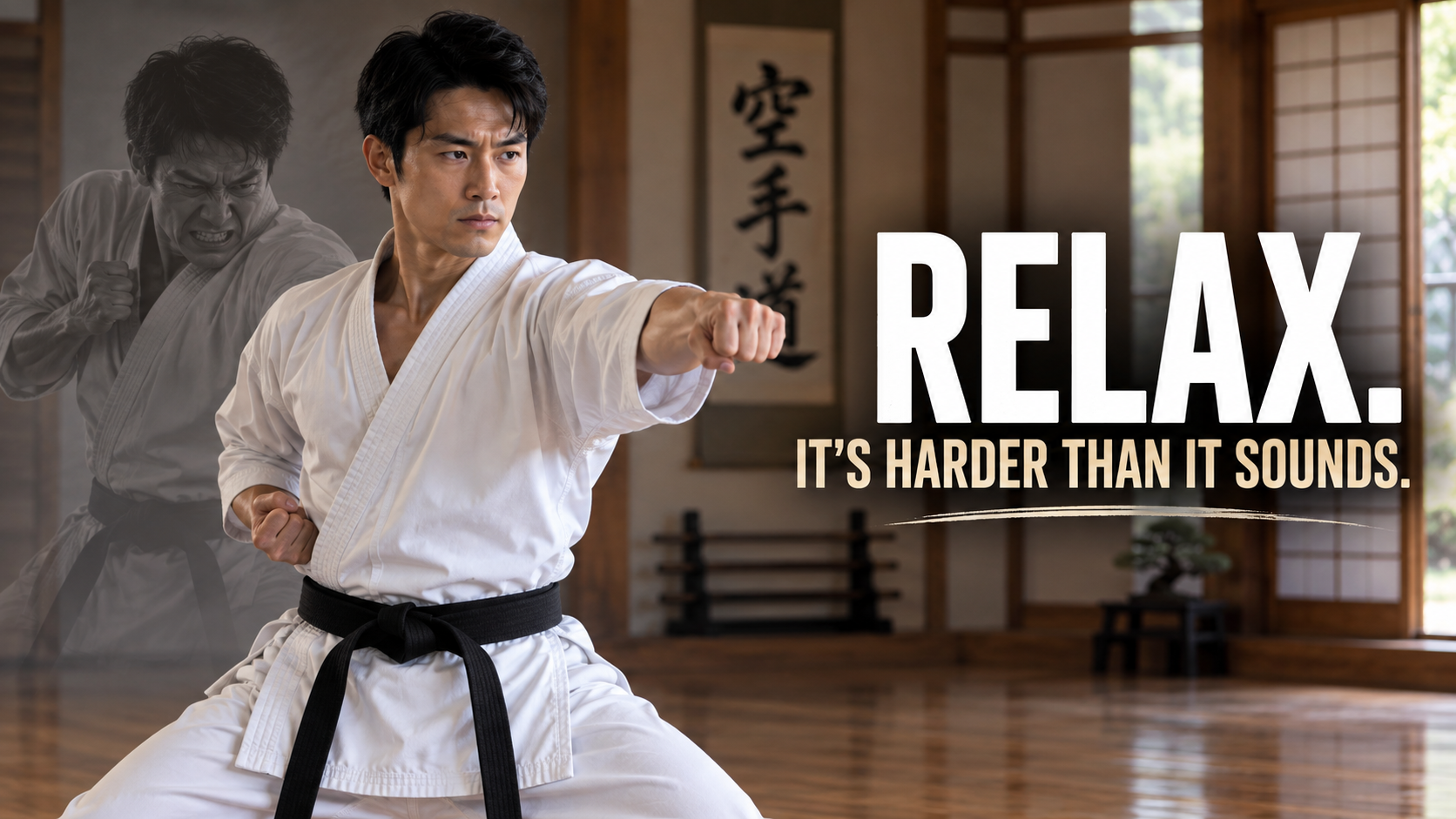
If you train karate long enough, there is one instruction you will probably hear again and again:
“Relax.”
For beginners, this can be confusing.
Karate is supposed to be powerful.
You are trying to punch harder, move faster, and keep your balance.
So why would your instructor keep telling you to use less strength?
In our dojo, one of the difficult lessons is that relaxing the body is often harder than tensing it.
If you’re new to karate, start with our simple beginner’s guide to karate.
Trying harder can sometimes make you less stable
One thing I often see is a student trying very hard not to lose their balance.
They tense their legs, stiffen their body, and try to hold themselves in place.
But instead of becoming more stable, they begin to wobble even more.
This is one of the strange things about karate.
Stability does not always come from trying harder to stay still.
Sometimes, the harder you try not to wobble, the more you wobble.
Karate movement requires the body to continuously shift its support and balance. If every joint is held rigidly in place, it becomes difficult to move smoothly into the next position.
Relaxation is important when moving the feet
For example, imagine moving one foot forward.
It is tempting to think only about the foot that is moving.
But the opposite leg also matters.
In many movements, you need to release unnecessary tension around the knee of the supporting leg so that your body weight and axis can shift smoothly.
This allows the other foot to move forward more naturally.
The same idea appears when turning.
Rather than keeping your body rigidly fixed over one point, you need to allow your support and axis to shift as the movement changes.
Too much tension can interfere with that transition.
So in karate, “relax” does not mean becoming loose or collapsing.
It means allowing your body to change position when it needs to.
The shoulders often reveal unnecessary tension
Punching is another good example.
Many beginners put a great deal of effort into punching.
But they often do not realize how much tension they are carrying in their shoulders.
In fact, it can be difficult to notice without looking in a mirror.
A student may feel completely normal, but when they watch themselves, they discover that the shoulder rises every time they punch.
When the shoulder comes up, the elbow may also begin to move outward.
The result is a punch that looks tense and less clean.
One thing we focus on is keeping the shoulder from rising.
Rather than lifting the shoulder with the punch, I sometimes think of pressing the shoulder downward.
When I do this, it becomes easier to avoid unnecessary tension in the arm as well.
Don’t only think about the punching hand
Another useful idea is to focus on the hikite, the withdrawing hand.
Beginners often concentrate almost entirely on the hand moving toward the target.
They try to make that arm stronger and faster, and as a result, they may tense the shoulder and arm even more.
Instead, we also think about pulling the opposite hand back strongly.
By consciously working on the hikite, I find it easier not to force the punching arm itself.
The goal is not simply to “push harder” with one arm.
The forward punch and the withdrawing hand are performed together as one movement.
For me, focusing on a strong hikite helps create a punch that feels powerful without making the punching arm unnecessarily tense.
You may not notice that you are tense
This is one reason relaxation can be surprisingly difficult to learn.
When you deliberately contract a muscle, you usually know that you are doing it.
But unnecessary tension is different.
You may have been raising your shoulders, tightening your knees, or stiffening your body for so long that it feels normal.
That is why mirrors can be useful in karate practice.
You may believe that your shoulders are relaxed until you actually see them rise during a punch.
You may believe that you are standing naturally until you notice how much you are trying to hold yourself still.
Learning to relax therefore begins partly with learning to notice your own tension.
Relaxation does not mean using no strength
There is an important distinction here.
“Relax” does not mean:
- make the body limp
- stop controlling the movement
- use no strength at all
Instead, it means reducing unnecessary tension.
You still need strength and control.
But you do not need every muscle to work as hard as possible throughout the entire movement.
The difficult part is learning when to use tension, where to use it, and when to release it.
That is why relaxing can actually be more difficult than simply trying harder.
A lesson that takes time
Beginners often assume that progress in karate means learning to use more power.
But with experience, another challenge appears:
learning what not to tense.
The shoulders do not need to rise every time you punch.
The punching arm does not need to do all the work by itself.
The legs do not need to become rigid every time you try to balance.
And the whole body does not need to be fixed in place before it can move.
Good karate movement often depends on being able to release unnecessary tension, coordinate both sides of the body, and allow the body to shift smoothly.
That is why instructors keep saying:
“Relax.”
It sounds simple.
But in practice, it may be one of the harder things to learn.
Comments